The Geologist, the Digger, and the Guide
A Retrospective of 50 years in the Greater Yellowstone
We live in a magical and mysterious location on planet Earth, the Greater Yellowstone, a land where the First People hunted buffalo and raised their families; a place near a super volcano that would be like a Hawaiian island if it weren’t in the middle of a continent. It is a place where the greatest expedition of discovery in North America attained the headwaters draining its greatest mountain range before continuing on to the Pacific Ocean. In another era, a great tropical sea existed here for millions of years. This idyllic land is a crossroads, a cradle, a beating heart, an eternal spring of life—but with somber memories of trials and tribulations.
I’ve lived in this extraordinary place a mere half century, since the summer of 1975, and I’ve built most of my life here. In 1990 I started one of the first web development and digital marketing firms in Montana, Earthtalk Studios. I received my master’s degree in geology that same year.
Two years earlier, in 1988, I had watched Yellowstone burn from high up in the Teton range as I completed the fieldwork for my thesis. During that devastating summer I was camped for weeks on the flanks of “Les Trois Tetons” (French trappers’ name for the Cathedral Group) as I studied the 65 Million year old Buck Mountain Fault. The majestic Cathedral Group was uplifted high above the surrounding terrain on that fault during the Cretaceous Laramide orogeny that formed the Rocky Mountains. Many days I awoke choked with smoke, and looking north could see three giant columns of smoke burning across Yellowstone National Park. So many things about this Greater Yellowstone region make one feel small and insignificant. And when we consider the fourth dimension, time, we realize the things that are so important to us in the moment are a mere blink of the eye in the grand scheme. I’ve lived an interesting life and I’ve reached a place in my evolution where I have the opportunity to share some of it with my fellow humans.
In my time here I have been fortunate to befriend three individuals who have been instrumental in telling the stories of science and culture of the Greater Yellowstone Geo-ecosystem through time: a geologist, a digger and a guide. I have documented these three individuals in the field over the last three decades, and I’m making these documentary films available on my YouTube channel: @ThisIsYellowstone (https://youtube.com/@ThisIsYellowstone)
These three individuals have been at the top of their fields in the Greater Yellowstone. Let me tell you a little bit about their contributions and stories of investigation and discovery.
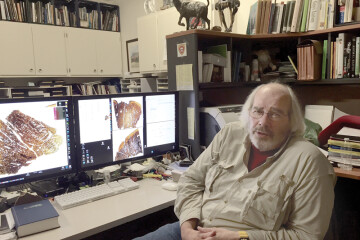
The Geologist
The geologist was Ken Pierce, a highly respected researcher with the United States Geological Survey, known as the guru of Yellowstone geology to his graduate students. In the mid-twentieth century he followed in the footsteps of Ferdinand Hayden, the first Yellowstone geologist. There is no argument that Hayden and, a few years later, Arnold Hague, made great contributions to the understanding of Yellowstone geology. They realized that there was a massive volcanic history in Yellowstone and that glaciers played a part in sculpting the landscape. They mapped the stratigraphy of volcanism and adjacent ancient ocean deposits in the midst of the great Rocky Mountain uplift. But they were mere observers and mapmakers without enough information to reveal the motive or the underlying causes of the features they studied. At that stage we were left with a cliffhanger, a whodunit.
The plot thickened just as Ken Pierce was receiving his PhD from Yale in 1964. Finally, a unifying theory of geology was accepted beyond a reasonable doubt. Plate tectonics had revolutionized geology just as Ken joined the United States Geological Survey in the mid-sixties. As a young, enthusiastic PhD in the vaunted survey, Ken was assigned the task of mapping the glacial geology of Yellowstone. His findings painted a picture never before seen of a massive ice cap nearly a kilometer thick, covering most of the Yellowstone plateau at the end of the last ice age. He received the prestigious Kirk Bryan award from the Geological Society of America for that pioneering work, but Ken was just getting started. He later developed theories of plate tectonic causation for the existence of Yellowstone, and addressed other geologic problems in the Greater Yellowstone Geo-ecosystem too numerous to mention here. He was still highly engaged in Yellowstone geology when he lost his battle with Parkinson’s in 2021.
The Digger
The digger was Les Davis, who became Curator of Paleo-Indian Achaeology at the Museum of the Rockies in the early 1990s and a giant of Montana archaeology. A Montana kid growing up on the Hi-line near Shelby, Davis later attended Montana State College in Bozeman, got his Masters at the University of Montana in Missoula, and his PhD from the University of Alberta. Only a few years before he came on the scene, deep human time was verified in North America. Between 1925 and 1935, both Folsom and Clovis Paleo-Indian cultures were discovered to have been associated with extinct mammals in North America, placing humans on the continent more than 12,000 years ago. Davis was in the thick of the heady search for early humans in the Americas. At the end of the last Pleistocene glaciation, sea level was around 100 meters lower than today, and a land bridge that is today beneath the Bering Sea existed between Russia and Alaska. It was also known that, as the ice age receded, a corridor opened on the east side of the Canadian Rockies, potentially providing a pathway for the first Paleo-Indian people to enter North America below the ice margin. This corridor opened onto the plains of northern Montana where Les grew up.
Les spent his 50 year career in an epic “search for the first Montanans.” He excavated the 15,000 year old Lindsay Mammoth in eastern Montana in 1967, found evidence of Folsom and Clovis people in the foothills of Montana mountains, and documented Paleo-Indian chert and obsidian mines from Yellowstone to Three Forks, Montana. No one before or since has matched his digging prowess. Les passed away in 2014 still planning his next excavation.

The Guide
The guide is still with us and continues to weave the history and tales of adventure and discovery across Montana. Wildlife biologist and guide Ken Sinay started Northern Rockies Natural History company in the late 1980s and, later, Yellowstone Safari, focusing on guiding in the Greater Yellowstone. In his storytelling he weaves tales of the early days of the Louisiana Purchase as the new Americans were “opening” the west to settlement. The reality of “discovering” lands that had been occupied by Native Americans for thousands of years is a concept detailed by Ken as he draws from his deep research to bring to life the harrowing stories of survival and adventure. Many of those who travel with Ken are treated to a cinema of the mind as he recounts the perils and achievements of the Lewis & Clark expedition, and later the boom and bust of the fur trade and other western exploitations. Ken weaves his animated tales while rowing his boat and sharing intimate wildlife experiences along the banks of the river.
Ken verbally paints the story of Colter’s Run like brush strokes on a Charlie Russell oil. After serving with Lewis & Clark’s Corps of Discovery, John Colter stayed in the wild west as a fur trapper. In one YouTube episode, Ken tells of Colter’s epic encounter with the Blackfeet near Three Forks, Montana, and his legendary escape, naked, on foot, as the Indians allowed him to run for his life.
Currently, Ken takes clients on the rivers of the Greater Yellowstone in his custom six-person flat-bottomed boat with his company, (https://MontanaRiverSafaris.com).
Creating these documentaries has been and continues to be a labor of love, and I’m now making them available on my YouTube channel: @ThisIsYellowstone (https://youtube.com/@ThisIsYellowstone). There are many more stories to tell and, as I reflect on my 50 years in the Greater Yellowstone, my mind is free to travel back in time to imagine this place in all its wondrous, colorful glory. It is truly a canvas of history and prehistory. Please join me to explore some amazing contributions to our understanding of this magical Greater Yellowstone Geo-ecosystem.
Daniel Smith is a geologist/filmmaker living in Bozeman, Montana. He currently operates Oolite Media LLC, a website hosting and media design company (https://Oolitemedia.com). He continues to add new science and cultural documentary content to his YouTube channel: (https:// YouTube.com/@ThisIsYellowstone) and website (https://ThisIsYellowstone.com)