Bozeman’s Historic Community Quilts

Over the course of the last two years, local quilters from the Gallatin Quilt Guild met regularly at the Gallatin History Museum to organize the quilt collection. Once the quilts were cleaned, evaluated, and properly stored, the group chose three pieces with high importance to the history of Gallatin County. After these quilts were stabilized with minor repairs, they designed a wonderful exhibit in the Main Hall of the museum. As you enter the room, the display case on the back wall catches your eye with the brightness of the “Capitol Story Quilt,” the “Pea Cannery Quilt,” and “That 70’s Quilt.” Each of the three featured quilts and the exhibit itself were created by many hands, making them true community projects.
The “Capitol Story Quilt” was made in 1892 to promote Bozeman’s bid for the Montana state capital. The quilt is signed in ink on the reverse by an assortment of local businessmen, women, and farmers and ranchers—some of whom are possible artisans of the piece. For many years, it was in the possession of the Story family of Bozeman and their names are among those inscribed on the back. This quilt illustrates the Crazy quilt pattern, with its assortment of fabrics in various shapes and sizes and ornate embroidery. The blocks were individually made, sewn onto a foundation, and assembled without batting.
In 1889, Montana became the 41st state admitted to the union. The next monumental tasks for its citizens included creating a state constitution, organizing a new government, and choosing a location for the state capital. Montana’s two previous territorial capitals were in the gold-rush-era mining camps of Bannack and Virginia City. In the early 1890s, Bozeman competed fiercely with Anaconda, Boulder, Butte, Deer Lodge, Great Falls, and Helena for the designation of state capital.
The state capital campaign fueled significant growth and development in Bozeman, as the small agricultural community transformed itself into a sophisticated city worthy of government offices. Proponents touted Bozeman as the city with room to grow and the most reasonable living costs. New hotels and commercial buildings were constructed, including the Bozeman City Hall and Opera House (1890) and the Bozeman Hotel (1891). An electric streetcar system was installed in 1892, providing convenient passenger transportation from the new Northern Pacific passenger depot on Bozeman’s north side to Main Street and the developing neighborhoods to the southwest. A gradual hill south of town became the intended location for the new state capitol building, and the area was dubbed the “Capitol Hill Addition.” A spacious South 8th Avenue included a boulevard and was intended to be the grand entranceway leading from Main Street to the capitol building.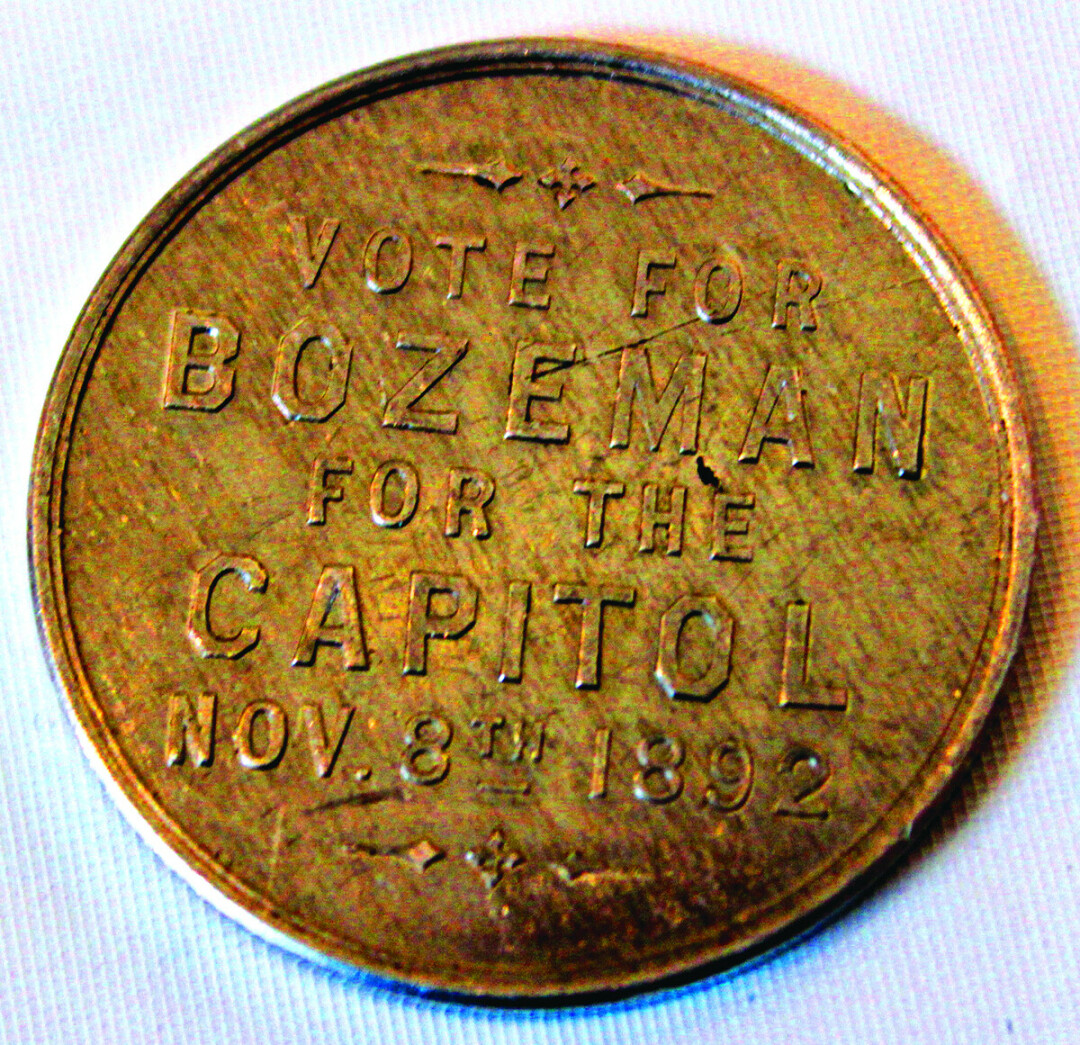
Anxious to obtain the economic and social benefits that accompany a capital city, Bozeman’s citizens campaigned heavily for votes. Promotional “Vote for Bozeman for the Capitol, Nov. 8th, 1892” medallions were produced and distributed, and prominent residents like the Nelson Story family participated in campaigns like this signature quilt to drum up support and to push votes. The election was unsuccessful, and Bozeman came in fourth behind Helena, Anaconda, and Butte. As a consolation prize, in 1893 Bozeman was gifted a land grant school called Montana State College of Agriculture and Mechanic Arts—today’s Montana State University.
According to information accompanying the “Pea Cannery Quilt,” this delightful piece was made by women who worked at Bozeman’s Pea Cannery. Like the “Capitol Quilt,” this piece is also a signature quilt, but features names embroidered with thread instead of handwritten in ink. The Chimney Block design incorporates fabrics like repurposed clothing and muslins, forming blocks assembled “on point” with a finished scrim edge. The center batting is a striped wool blanket which is visible through the aging fabric. Research into the embroidered names and analysis of the fabrics used suggest the quilt was made between 1927 and 1930. It has deep ties to Gallatin County’s farming and industrial past.
Agriculturally rich, the Gallatin Valley attracted farmers and ranchers in the 1860s. These activities led to the establishment of associated industries like flour mills, malting plants, seed companies, and a cannery. In addition to wheat, barley, and other grains, agriculturalists found that peas grew well in the area. In 1911, the Jerome B. Rice Seed Company of Detroit, Michigan determined the Gallatin Valley would be a prime location for intensive pea production, and the industry was born.
The Gallatin Valley Seed Company and other seed businesses in Bozeman processed and packaged area seed peas for shipment around the country. In 1917, local businessmen Thomas Byron Story, Lester P. Work, and L.L. Brotherton established the Bozeman Canning Company, which produced thousands of cases of canned peas that fed troops in Europe during World War I. Local growers harvested pea crops beginning in July, which would be quickly transported to the Bozeman Canning Company facility on Bozeman’s northeast side. Peas were processed and canned in intense round-the-clock operations that employed hundreds of seasonal workers. Most seasons produced an average of 200,000 cases of canned peas. At its peak production in 1926, the Bozeman Canning Company shipped over 320,000 cases. Many local women and teenagers supported their families by working at the cannery and seed companies through the Depression years and both World Wars. Women employed at the cannery reported a sense of camaraderie and community, as this signature quilt illustrates.
The Bozeman Canning Company was eventually acquired by PictSweet Foods, but production dropped significantly following World War II. A reduction of government contracts, crop disease, and an increase in the popularity of frozen vegetables contributed to the industry’s decline. The factory buildings shut down permanently in 1958. Today, the old Bozeman Canning Company complex adjacent to North Rouse Avenue has experienced a revival, and a variety of restaurants and shops occupy the renovated canning company buildings.
Though signatures and names are not the main focus of the third and final quilt, it was also created by a community effort. Affectionately dubbed “That 70s Quilt,” this piece is an assembly of twenty-five individually quilted blocks, each depicting a different Montana theme. Brightly-colored polyester and cotton fabrics form scenes that feature hand appliqué and embroidery. This work of art commemorates women’s contributions to Montana’s development, and highlights the history of women using textiles to express political opinions, advocate for change, and build community. Quilters who contributed to this piece include Montana legislators, artists, and writers whose names or initials are included in the blocks.
From Bozeman’s beginnings, local women campaigned for causes they held dear, including rational dress movements, temperance, and suffrage. In Montana, suffrage was attained in 1914—six years before the 19th Amendment was ratified. After achieving the right to vote, suffrage organizations refocused on educating women about government processes and important issues. Bozeman’s League of Women Voters (LWV) was established in 1920 and supported female voters of all political parties.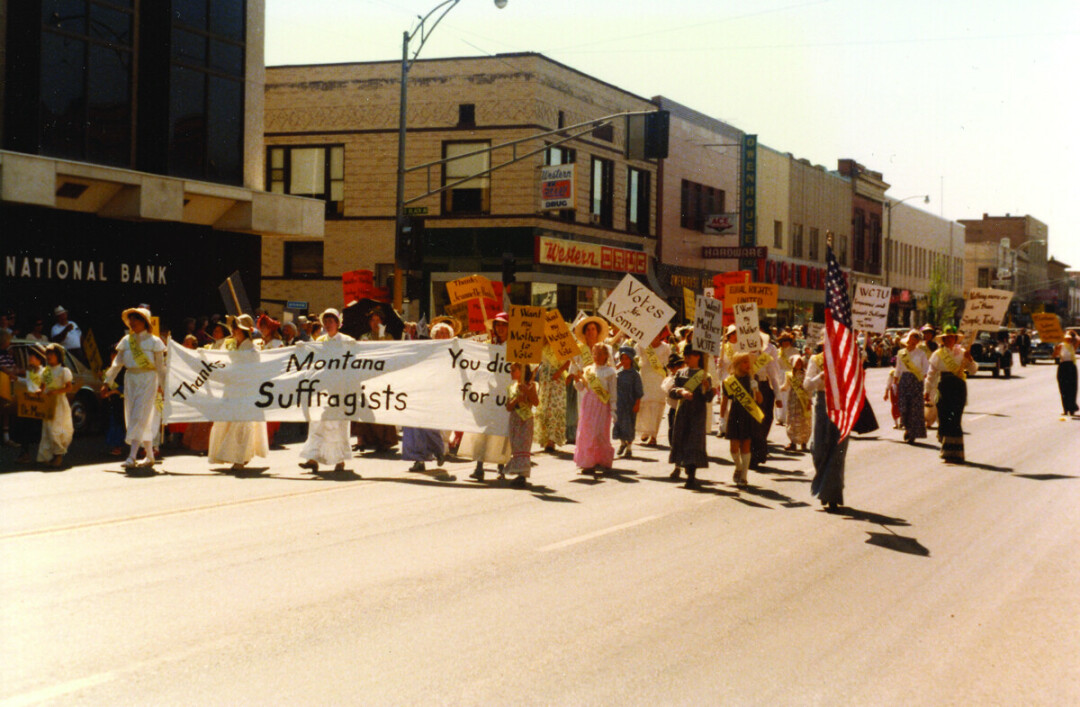
Bozeman’s LWV chapter, along with many state and national groups, went dormant during the Great Depression and World War II. The group revived in the late 1950s, and they began conducting studies of pertinent issues like local government, schools, parks, housing, and social services. Population growth in Bozeman in the 1970s also stimulated increased attention on land use issues, as well as a focus on keeping Main Street vibrant. Several members of Bozeman’s League of Women Voters were active participants in the Montana Constitutional Convention in 1972, which revised the state’s outdated document, which had been developed during statehood in 1889.
“That 70s Quilt” was created in 1974, amid national attention on the Equal Rights Amendment. The Montana Women’s Political Caucus was formed by women in the state legislature, with the goal of eradicating discrimination based on sex. During the 1970s, Montana House and Senate seats occupied by women jumped from one to fifteen. To draw attention to sexism in the legislature, Senator Pat Regan of Billings adopted a stuffed pig mascot that wore a button with the title “Male Chauvinist Pig.” Any male legislator who went too far with sexist remarks would likely find the pig delivered to his desk.
We invite you to visit the museum to see these colorful masterpieces in person, and to see firsthand how art and history intertwine. The Gallatin History Museum would like to thank our volunteers, who put in hours of work to research, repair, stabilize, and create a beautiful display of these historic quilts. We extend our deepest appreciation for the knowledge, dedication and hard work shared by Pat, Catherine, Catalina, Nancy, Renee, JB, Darcy, Barbara, LaDonna, and Scarlett.