From Sunset to Sunrise: The Path of Discovery to the Samuel Lewis House
“Security and peace do not lead to discovery.” - Carl G. Jung
As a child, my vivid imagination helped me stay open to attract synchronistic occurrences. We all have stories to share, and these coincidences helped to shape my life’s story.
I grew up in Wessington Springs, a town of nearly a thousand residents in rural South Dakota. After graduating from the University of South Dakota, I married Dick Tenney, a second-year medical student. This union proved to be a catalyst for a life filled with interest and wonder. A mutual desire to explore east of Minneapolis, MN, compelled us to pack our lives in our car and head for unknown sights and certain adventure. We lived many places during and after Dick completed medical school, including Philadelphia, Boston, Vermont, California, and Korea, which was our first experience in a foreign country.
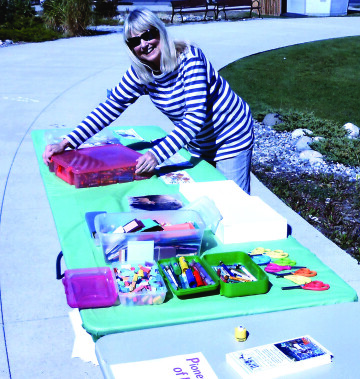
Eileen Tenney
In February 1973, we seized the opportunity to provide medical care in Haiti. We were buzzing with anticipation on the short flight from Miami to Port Au Prince, unprepared but excited for the completely alien land we’d step onto. The moist, hot air with a distinct, welcoming odor hit us first. We stood in awe of the airport lobby crowded with locals, knowing right away that we had made a “good move.” Roads were teeming with pedestrians headed to market during our fast and furious taxi ride into the city, and though poverty was evident everywhere, the vivacious population seemed to mask it.
Our two-month stay in Haiti was what we felt life should be all about: making a difference. Dick saw patients who were lined up for care after walking for miles or days. Most were seriously ill with diseases unseen in the United States. Many were malnourished or starving. I worked in the pediatric ward and as a volunteer teacher in the compound school. The Haitian people were warm, friendly, and filled with a zest for life; by the time we departed, we knew we’d return.
Back in Vermont, we were looking for a place to call home. We liked the idea of a small town with a college or university, and Bozeman fit the criteria. I flew to Bozeman to choose a house for us. Because our resources were limited, I didn’t want to see houses above $40,000. Even in 1975, there weren’t many available at that price. After seeing a few houses that didn’t seem right, I remembered a photo a realtor had sent to us of an older brick house with some character. Having grown up in an older home, I preferred them and was anxious to see this one.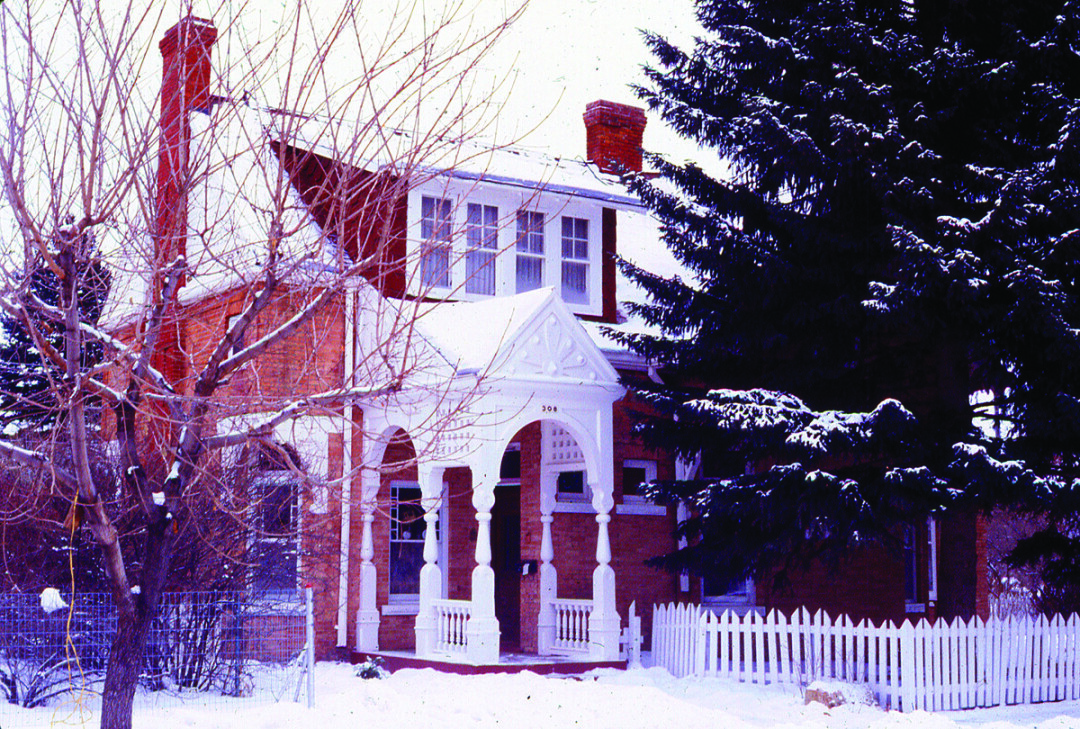
Outside, the house was a sorry sight. The bricks had been painted red with graffiti carved into the surface, the gingerbread wood trim was rotting and crumbling, and the yard needed maintenance. Maybe I should have been turned off, but I was keeping an open mind. As I entered the house, which was a rental at the time, my first impression was “oh dear.” There were mattresses on the floor in many rooms with toys, clothes, and debris strewn throughout. The house needed a new furnace, storm windows, insulation, roof repair, and uneven floors in the basement made the shifting foundation evident. A gentleman also viewing the house said to me in private, “Who would want this house?” I answered, “I don’t know.” Inwardly, I was thinking, “I do.”
As I looked beyond the needed repair, what I saw and felt was amazing. There was a fresco ceiling in the living room. Even though it was damaged by water and darkened by soot and dust, it seemed a miracle it had survived through the years. Many of the rooms had stunning stained glass windows. Some of the woodwork had been stripped, revealing the warm-toned natural hardwood underneath. The coziness and character of the house shone through the disarray, seemingly begging, “rescue and love me.” So, I did, for an affordable $36,000. I flew back to Vermont knowing that, though renovation costs would be high, I’d made the right choice. The home at 308 South Bozeman would be perfect for our family.
Over that summer, we returned to Haiti and volunteered at the hospital. Once again, our experiences were priceless. We adored the country even more the second time. Knowing we had a new/old home to decorate, we collected colorful paintings, woven rugs, and wood and metal art pieces. We loved Haitian art and couldn’t seem to get enough of it. But when it was time to leave Haiti, we were looking forward to our new lives in Bozeman.
Excitement escalated and my apprehension showed as we made the turn onto South Bozeman Avenue. While I’d visited the house in person, Dick and our children, Megan and Braden, had only seen it in a black-and-white photograph. We parked on the opposite side of the street to get a full view of the property. At first, there was silence. Then a little voice asked, “Is this it?” You can always count on honesty from children, and I could hear disappointment in Megan’s voice. It looked worse than I remembered, tall weeds in an unkempt yard overshadowing the house’s character. I replied with my optimistic voice, “But wait till you see the inside!” When we entered, I enthusiastically pointed out the strong points: the stained glass, fresco ceiling, layout of the rooms, and a sense of homey-ness within. When the children ran to explore, yelling, “Wow, this is great,” I let my guard down.
What fun we had, arranging antique furniture and displaying our cherished Haitian art and artifacts. As we became involved in daily life, thoughts of Haiti were replaced by our Bozeman adventures. Winter was nearing, so we focused on making the house more energy efficient. We had the furnace replaced and added insulation and storm windows. On our limited budget, the cosmetic renovation would have to wait. We easily adjusted to slanting floors, no shower, and an outdated kitchen. In time, our home would be made more convenient and aesthetically pleasing, but we didn’t feel the need to make immediate changes. The quaint house paired well with our eccentricities, making a perfect match.
Two years later, Montana State University student Marilyn McMillan rang our doorbell. She introduced herself and asked for my permission to research our house for a class. I was interested in knowing the history of our home and I didn’t believe the rumor that it had been a house of ill repute. It had gotten that reputation because there was a door to the outside from every downstairs room. We were excited to see what Marilyn could discover.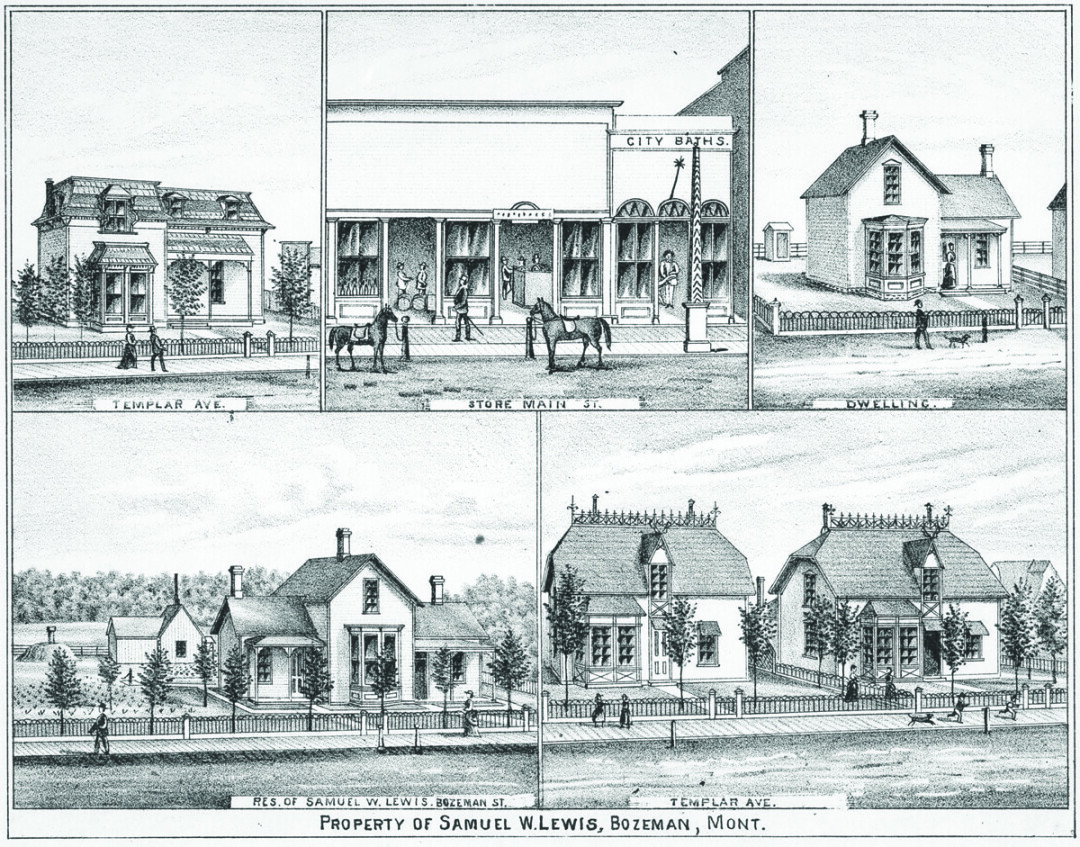
About two months after Marilyn approached me, she returned to present me with the obituary of Samuel Lewis. After I read the first sentence, my legs felt weak, I was dumbfounded, and then I became so excited I could hardly contain myself. Samuel was born on the Island of Haiti. It was a perfect “ah ha” moment. Ninety-four years after it was built, I chose Samuel’s house for my family, and we brought with us our collection of Haitian art, artifacts, and a love for his native culture. Now, the feeling of belonging I had upon entering the house made sense. We all felt it was meant to be. Knowing about Samuel and his sister, Edmonia, also mentioned in his obituary, charted the direction of my life’s path. I soon discovered Edmonia was half Chippewa. Her Indian name was “Wildfire,” and Edmonia, her mother, and the tribe referred to Samuel as “Sunrise.”
I was happy to know why I had chosen Samuel’s house, but I thought that would be the end of it. I was so wrong. In 1986, we moved to Chicago and rented out the Samuel Lewis house in Bozeman. We would be back someday, for no one else would have such a connection to our home. I enrolled in Columbia College Chicago and began a master’s program in Interdisciplinary Arts Education. One weekend, we were browsing in a Wisconsin bookstore when I saw a book called Women Artists: Recognition and Reappraisal from the Early Middle Ages to the Twentieth Century. I opened a random page, and to my amazement, Edmonia Lewis was looking back at me. That discovery led to a new topic for my research, sparking an enduring fondness and fascination for Edmonia and her remarkable life.
In the many articles I read about Edmonia, some mentioned a brother, sometimes calling him “Sunrise,” but never Samuel. I wondered why I knew him as Samuel, when no one else seemed to. It wasn’t long before I realized no one beyond Bozeman knew Samuel Lewis’ obituary had been discovered. By the time Dick’s work took us to Livermore, California, I knew that the Martin Luther King Library in San Jose owned three of Edmonia’s sculptures, “Asleep,” “Awake,” and the bust of “Abraham Lincoln.” I went to the information desk at the library and told them why I had come to see Edmonia’s sculptures. I was met with extreme enthusiasm by Librarian George Kobayashi and Mary Parks Washington, who was a member of The Links, Incorporated, a non-profit organization consisting primarily of professional African American women. It was a revelation for them to learn the given name of Edmonia’s brother, and to discover the 1881 home he had built was still standing in Bozeman, Montana.
The San Jose Chapter of The Links had raised money to craft new pedestals for Edmonia’s sculptures, and they were planning a celebration of Edmonia’s life and art in conjunction with the unveiling of her sculptures for the new display. Mary invited me to take part in the celebration. I was overjoyed to share new information about Edmonia’s half-brother, “Sunrise” Samuel Lewis. It added a perspective to Edmonia’s story that gave Samuel the recognition he deserved. Because of his financial help, Edmonia was able to develop her exceptional artistry, and ultimately achieve an outstanding place in history as “The First Internationally Acclaimed African American Sculptor.” Her sculptures are on display in museums, galleries, and private collections throughout the United States. My thesis about the lives of Edmonia and Samuel was completed in 1991, but my relationship with the Lewis siblings was far from over. The path of discovery continues to be illuminated to this day. The firefly never tires, and the narrative has just begun. e
Haitian Creole proverb:
Chak KouKouy Klere pou je pa yo.
Each firefly lights (the pathway)
for his own eyes.
Eileen Tenney presented this research at the Gallatin Historical Society in 2006. To learn more about Samuel and Edmonia Lewis, we invite you to attend an open house at the Tenney/Lewis home, 308 S. Bozeman Ave., on Saturday, September 12. Call (406)522-8122 to purchase tickets. Proceeds benefit the Gallatin History Museum. Exhibits on Samuel and Edmonia Lewis are also featured at Tinworks Art and the Museum of the Rockies in Bozeman in 2026-2027.