Bozeman and Bridger
A quick study of the names used for places and features around our town—creeks, streets, mountain passes, businesses, a mountain range, and the city itself—would give the impression that persons named Bozeman and Bridger were the most important to us. After some research, one finds that the men with these names were engaged in the same process, transporting people to our valley, at the same time.
John Bozeman was first reported in Montana in the summer of 1862 at Granville Stuart’s settlement at American Fork near Gold Creek over the Divide. He was 25 years old. Jim Bridger first entered the land that became Montana in 1822 as part of Ashley’s One Hundred, an expedition of fur trappers recruited to travel to the Rocky Mountain west. He was 17 years old. To be fair, it is doubtful that either of them had ever heard the word Montana when they arrived.
The Oregon, or Overland Trail was established in the early 1840’s as a transportation route for emigrants to Oregon and California. Tens of thousands traveled the trail. The discovery of gold in California accelerated the vast emigration. The Native American tribes whose land the trail passed through were placated by the government assuring them that, other than a few forts and trading posts, there would be no settlement. It was just a road. That changed with the discovery of gold in Montana in 1862. Suddenly, many people wished to be in Montana. Some already on the Oregon Trail wanted to divert to Montana. Of course, there was no existing road or trail. For some time, the route to the goldfields struck north from Fort Hall in Idaho Territory. But there was talk of establishing a shorter road leaving north from Fort Laramie. There were men who were willing to guide parties for a fee. Two of these were John Bozeman and his partner John Jacobs, an older trapper. They had arrived at the diggings around Bannock the first year, but had little luck. During the harsh winter, they decided that guiding others would be more lucrative.
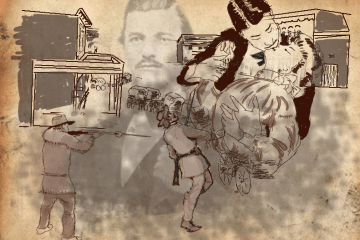
Their route left the Oregon Trail beyond Fort Laramie, ran north through the Powder River country, crossed the Bighorn, then the Yellowstone, led over Bozeman Pass into the Gallatin Valley, then went on to the goldfields to the southwest. A road of sorts did exist, one made by Indians, which was the main problem with the route. The Indians did not want any emigrants in this area and had been assured through treaty that there would be none. The lure of gold was impossible to resist. People wanted to get there and others, like John Bozeman, were willing to guide them. Bozeman was involved with the trail that bears his name for just two years, 1863 and 1864. But the trail sparked much controversy, expense, and a war, which the U.S. Army lost. Forts to guard the wagon trains were built, and later abandoned. Emigrants took to the trail; many made it, some turned back, and some did not make it. Battles were fought, which the Indians generally won. By 1868, the trail was given back to them. Chief Red Cloud and the Sioux had prevailed.
Bridger was employed by the U.S. Army as a scout for the troops dealing with the Sioux. He was paid five dollars a day. The Army privates were paid ten dollars a month. The commanding general in Omaha wired the Fort Laramie commander to fire Bridger to eliminate the expense. The officer wrote back that carrying out this order was not possible. Evidently, Bridger was worth fifteen men. In 1864 this commander, Colonel Carrington, asked Bridger to find an alternative route to the goldfields, one which would eliminate the conflict with the Sioux. He led a couple of wagon trains up the west side of the Bighorn mountains, the east side of the Wind Rivers. The Indians there, the Shoshone, were friendly, and related to Bridger by marriage. Thus, the people were safe, but the livestock suffered, as Bridger’s route had little grass and uncertain water. Bridger guided two groups on the route. Bozeman’s partner Jacobs guided one. Then the route was abandoned and the war was fought over the Bozeman Trail.
After beginning on opposite sides of the Bighorns, the trails met at the Yellowstone River. Bozeman’s trail then passed through where Livingston is now, over the pass named for him and into the Gallatin Valley from Jackson Creek and Kelly Canyon. This was the route of William Clark sixty years before. Bridger left the Yellowstone sooner and rode up the Shields, passed over into Bridger Canyon and entered the Valley coming down Bridger Creek. There are a couple of accounts of these trips, but today’s place names did not exist then, and other names were varied. Clark had named the Shields River for one of his men. It seems definite that Jim Bridger’s route went up that stream. The accounts then mention Bridger Pass. Could this have been Battle Ridge? But it would seem that the natural route from the Shields Valley would be up Brackett Creek. There is no real pass from there through Bridger Canyon into Bozeman, just the slope that leads up toward Bridger Bowl from Brackett Creek, then descends a couple hills into the Canyon. There is no way to really know exactly which route was taken, or even if the same route was followed more than once.
Yet, certainly someone saw Jim Bridger leading his wagons from the mouth of the canyon. A wagon train rolling into the Gallatin Valley in 1864 would have been a major event. Just as certainly, Bridger riding in at the head of that column was how the creek, the canyon, and the mountains acquired the name Bridger. The dialogue can be imagined:
“Where did they come in?”
“From that canyon to the northeast.” “Bridger came down that creek?” “Yup.”
Soon enough, the creek that Bridger came down would have been called Bridger’s Creek. Then, the “mountains north of Bridger’s Creek” would have become Bridger’s mountains. Next, the name would have been used in a letter, then in a newspaper article, then recorded on a map. Jim Bridger came into the Valley, then left, guiding his wagons on to Virginia City. His name remained.
After 1864, the Bridger Trail was not used. This safer route was simply too hard on people and stock. The Bozeman Trail, dangerous but more forgiving, got all the traffic. The lure of gold was stronger than the fear of the Indians. In 1864 and 1865, some turned back when confronted by the Sioux, but most continued and made it through—sometimes without mishap, often with stolen stock, always with fear. By 1866 the government realized that emigrants were going to use the trail regardless of treaty and official disapproval. A commission was sent to Fort Laramie to convince the Indians to allow the pioneers through their hunting grounds. The Sioux could not help but notice that great numbers of soldiers and teamsters were present to begin the construction of a series of forts to guard the trail.
Their consent did not seem to matter. Most, led by Red Cloud, left the fort. What followed was three years of guerrilla warfare. The Army was undermanned, underfunded, and inept. They were completely unable to understand or adapt to the Indian tactics. After a series of raids that left the Army embarrassed and demoralized, the forts were abandoned. The great irony was that during the tragic and futile episode the wagon trains had already stopped using the Bozeman Trail. It was less safe while the Army was there.
Travelers began to use the steamboats that came up the Missouri River to Fort Benton to reach the goldfields, and Bozeman. In 1869 the transcontinental railroad was completed, making the entire journey much more convenient. John Bozeman was killed by Blackfeet near Livingston in 1867. Jim Bridger was still scouting for the Army in Wyoming. It is unknown if he ever traveled back to the Gallatin Valley. By then, the names Bozeman and Bridger were permanently attached to southwest Montana.
Did John Bozeman and Jim Bridger ever meet? That extremely intriguing question cannot be answered. Bridger led a wagon train into the Gallatin Valley in July 1864. Bozeman City was platted by Bozeman, Daniel Rouse, and William Beall a few weeks later. Bridger is known to have been in the tiny town at least once more that year. Bozeman was likely in town for much of the rest of that year. The number of people here at the time numbered in the dozens. Who knows? Bozeman’s partner, Jacobs, had been in the mountains a long time. It is likely that he knew Jim Bridger. Certainly Bozeman and Bridger were aware of each other. Quite possibly, they met. Regardless, their names are entwined in the history of our city. They are two of the founding personalities of the area. And two of the most interesting.
Much of the information presented in this article, beyond my own obvious and inexpert commentary, is from Dorothy Johnson’s excellent book, The Bloody Bozeman.