Midwest Trip
Familiar yet exciting, the Interstate 90 run from the benches of northern Wyoming up into the Little Bighorn valley was filled with anticipation: the arrival in Montana, the comfort of home. We made that drive recently after a long road trip through the Midwest. Nine or ten states, cities and scenery. Being away, the comparisons are inevitable. Coming home, we remember that it is easy to show off the grandeur of Montana to visitors, but harder to explain the attachment that those of us who call the Big Sky home have for it.
Interstate 90 is the artery that connects Bozeman with the world east and west. Our trip began eastbound more than three weeks before that return. Soon enough, we faced a choice. Stay on 90 through the Crow Reservation, enter Wyoming, and make the drive east through South Dakota, or cut north following the Yellowstone River along Interstate 94, which begins at Billings, move through eastern Montana and into North Dakota. Since my wife Ruth and I are both originally from Illinois, we have lots of family there. We have made the trip back and forth dozens of times. But this time the choice was easy. Our first destination was Minnesota, so we drove the North Dakota route.
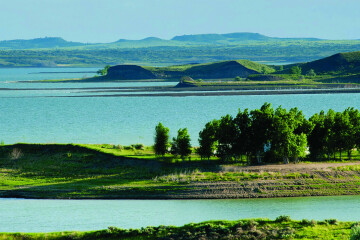
The comparisons began. Many states, especially in the west, have straight line boundaries that are only apparent on a map, or at the welcome sign. North and South Dakota, made up of badlands and farmlands, are virtually the same as eastern Montana. I just found out, courtesy of Wikipedia, that the area of the two Dakotas combined is almost exactly that of Montana; 147,000 sq miles. Big, wide open places. All three states have the Missouri River; we also have the Yellowstone, and Montana has a western section full of mountains and valleys. Still, I enjoy the drive across the Dakotas, especially the gradual contrast from the more wild, western parts to the domesticated east. The Midwest begins there somewhere, perhaps along the 100th meridian, where rainfall diminishes on the western side. The Midwest also seems to be divided into rougher and more cultivated sections. This divide is north and south. The northern sections of Minnesota, Wisconsin, and the Upper Peninsula of Michigan contain much wild country. They are defined by vast forests and the Great Lakes. We hiked in the forests and on the lakeshores. In the upper Midwest, the farther north, the more conifers, and less hardwoods. The pines and firs begin to look like a Montana mountain scene. The UP in Michigan has aspens, which I did not expect. In one section of woods the entire ground was covered with maple seedlings six inches high. Beautiful. The lakes provided a distinct contrast with what we are accustomed to. Neither Flathead nor Yellowstone can come close to the expanses of Lake Superior. Locals refer to it as the unsalted sea. In windy conditions, which are normal, the beaches seem like the ocean. We enhanced this experience with a kayaking trip. It was possible to see the sandy lake bottom in 40 feet of pristine water.
Another highlight was the Mackinac bridge, which links the two sections of Michigan across the strait between Lake Michigan and Lake Huron. It is five miles long, with a middle section suspension bridge that towers 550 feet above the water. It is the longest bridge in the western hemisphere. We drove across the bridge in early morning fog without traffic, which made it even more dramatic than usual. Well, Montana has nothing like this. Our longest bridge, over Lake Koocanusa, is about half a mile.
Later in our journey, we visited the lower Midwest states: Illinois, Indiana, and Missouri. The beauty there was more subtle, the springs and streams smaller, the hardwood forests thick, but limited. Bear spray was not needed, but bug spray was. Hikes were walks without much elevation. The town we stayed in was pretty small; things were relaxed, simpler. The natural world there had distinct boundaries; cornfields or towns were always nearby. It was familiar ground, the place where both Ruth and I grew up. The landscape is comforting and comfortable. It is structured in a familiar grid pattern, town and country. There is no wilderness, and the woods are small and scattered, but the large, orderly corn and bean fields provide a wide open view of a dramatic, cloud-heavy sky.
Our return trip navigated through Kansas, Nebraska, and eastern Wyoming. The border of Missouri and Kansas is one of those straight lines, until it encounters the Missouri River at Kansas City. Then, it meanders off to the northwest. Kansas was not flat and boring in the eastern section. All the way through Lawrence, Topeka, and Abilene, it was rolling with pleasant stands of hardwoods. We took the backroads up to Red Cloud, Nebraska on a fun Saturday morning drive. The towns in Nebraska reminded me of Forsyth and Miles City on the Yellowstone, but there, the river is the Platte. Cheyenne was a welcome night’s rest stop before our last push on Sunday. The drive on Interstate 25 north through Casper and Buffalo is very familiar, yet it was beautiful at sunrise due to our uncharacteristic, early start. I even missed the free breakfast at the motel.
Our trip spanned most of September. It was too early almost everywhere for fall colors. Yet, the transformation had begun in the north. There was an occasional bright red maple within the still, green forest. Farther south, the oaks had begun to take on a coppery color. But it was not until we returned to Montana late in the month that we saw some yellow on the riverside cottonwoods, and golds in the hillside aspens. The colors elsewhere will have to wait for another year. This year we are back in Bozeman for that show.
When travelling east from Bozeman, the key difference with these other states and landscapes soon becomes obvious—there are no mountains. And unexpected things, like whitewater canyons in Minnesota, or sand dunes in Indiana, do not make up for that lack. Soon enough we are scanning the horizon, searching, hoping for a cloud bank to transform into the peaks that we cherish. Do we take them for granted here in the Gallatin Valley? Of course. Even if we rarely drive up Bridger Canyon or travel to Hyalite, our gaze is daily drawn to the hills and the mountains. Some of our fields and the subdivisions where the fields used to be could easily be transported to any of these midwestern states. But the dramatic background, the view beyond is special.
As I write, I realize that my thesis statement above is faulty. It is not hard to explain our love affair with Montana. That part is as easy as showing it off when we have visitors. The hard part is convincing others that Montana is the best place. The Last Best Place, as one of our mottos tells us. Our literary statements can be tough to defend. I say that there can be large skies elsewhere, even huge skies somewhere, but there is only one Big Sky. And the ski resort is only part of it.
Is all of that necessary? Our proclamations begin to sound like boosterism, bragging, BS. Is ours the Last Best view? Is it better than all others? Well sure, if we are challenged; but realistically, what is special about our place is that it is our place and no other. Things here are the best for us and that is good enough. The GOAT controversy is fun but essentially meaningless. That is the takeaway from our trip east, from any trip. This valley, this town, belongs to all of us, and we cherish it. It is enough to say that we love this place, feel a connection to it, and are proud to live here.
Now for a small self-lecture. At one town a thousand miles from here, someone asked where we were from. When I told him he quipped, ‘Bozangeles!’ I just smiled and said; Well, yeah, it is pretty nice. The next time I am stuck in traffic on 19th, instead of grumbling, I am going to gaze up at Baldy and see if there is a dusting of snow or some aspen color on the slopes. And think about the long detour we took to avoid Chicago, or the bumper to bumper race through Kansas City. It should not take a long trip elsewhere for us to come home and appreciate this special town more than we already do, but it does not hurt. On a sunny warm afternoon a couple of days after returning to Bozeman, when the unpacking and settling in was done, we hiked up Drinking Horse Mountain late in the afternoon.
As the low light came through the last fir trees on the trail near the summit, Ruth said; Now, I feel home.